
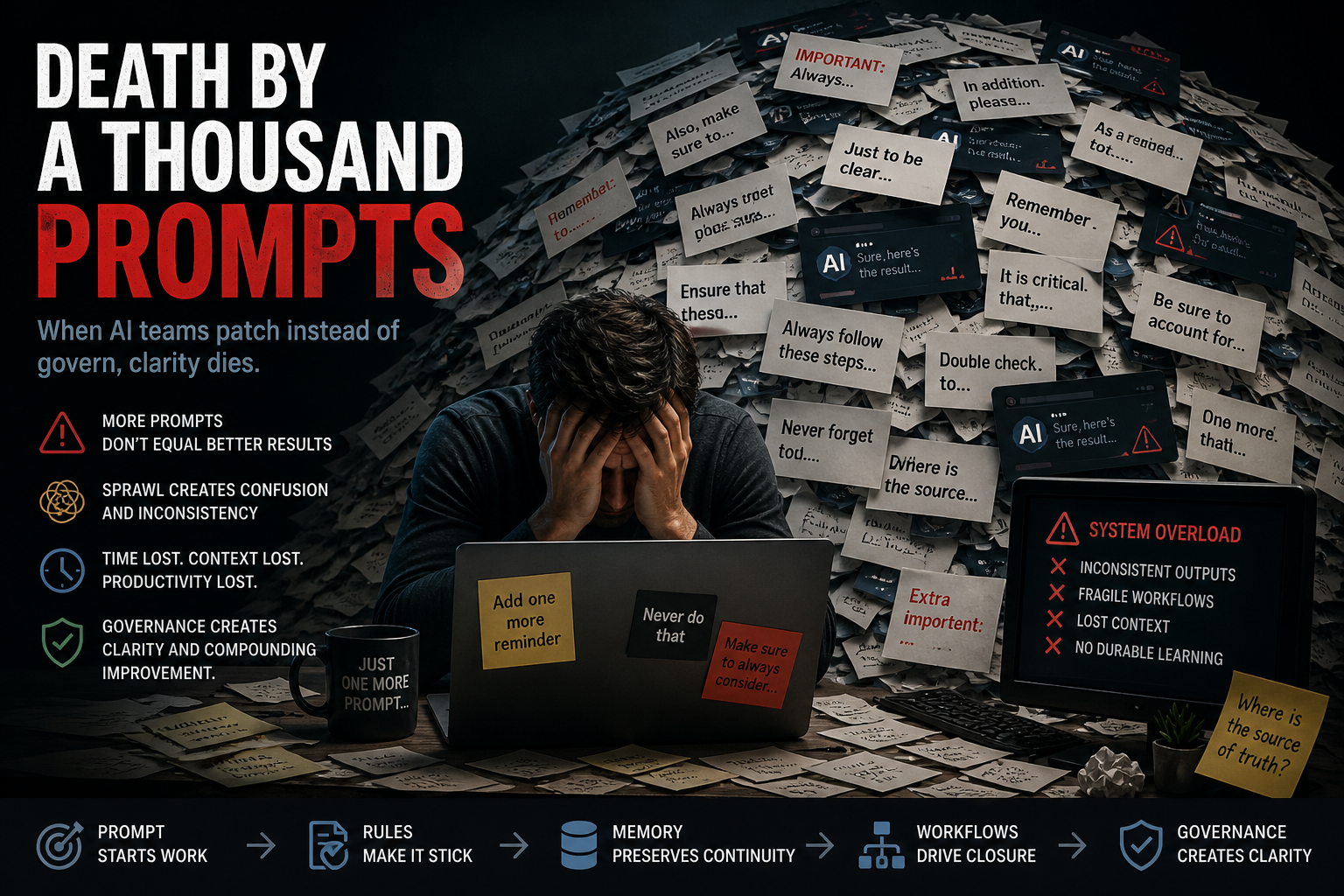
Most AI teams do not fail because one prompt was bad.
They fail because every miss, regression, awkward result, and near miss gets patched with one more instruction.
Add one more reminder. Add one more warning. Add one more exception. Add one more paragraph explaining what should have been obvious. Add one more "always do this." Add one more "never do that."
At first, this feels like progress. The system got something wrong, so now the team has corrected it.
But over time, the prompt stops being a tool and starts becoming sediment.
That is how you get death by 1000 prompts.
The problem is not prompting itself. Prompting matters. Clear instructions reduce mistakes.
The problem is prompt accumulation without governance.
What death by 1000 prompts looks like
You can usually spot it quickly.
The bootstrap prompt becomes enormous. The same rules get repeated in every session. Agents need hand-carried context because the important behavior does not live anywhere durable. Simple tasks only work if someone remembers the exact latest wording. The team keeps adding exceptions, but very little is being simplified. Merged lessons never become rules. The system becomes more fragile as more guidance is added.
This is not operational maturity. It is operational debt.
The team starts thinking the fix is better prompting, when the real problem is that the system has no stable way to learn.
Every failure becomes another patch in active text instead of an improvement in how the system actually operates.
The real issue is not intelligence. It is operating shape.
A lot of prompt sprawl is actually a design smell.
It usually means one or more of these things are missing:
- no canonical rules
- no durable memory
- no explicit workflow closure
- no distinction between review, proposal, and live change
- no promotion path from incident to lesson
- no stable project source of truth
- no cleanup discipline after work lands
So the agent keeps depending on live chat and oversized prompts to behave.
That creates a strange illusion: the system looks highly instructed, but it is actually weakly governed.
It has lots of words and not enough structure.
Prompts should start work, not hold the whole system together
A prompt has a role.
It should help frame the task, the current objective, the immediate constraints, and the operating mode.
That is useful.
But a prompt should not be the only thing stopping chaos.
If the same correction has to be repeated again and again, it is probably no longer just prompt content. It is a rule that has not yet been promoted into the system.
That is the key shift:
- a prompt is situational
- a rule is durable
- a spec defines scoped truth
- memory preserves continuity
- a workflow defines repeatable closure
- governance decides what becomes stable
Once you see that distinction clearly, a lot of AI delivery problems become easier to diagnose.
Why teams keep falling into this trap
Because prompt patching is easy in the moment.
Something went wrong, so you add another sentence. Something drifted, so you add another warning. Something was misunderstood, so you add another block of explanation.
That gives immediate relief.
But it also hides the deeper question:
Why did this need to be said again?
If the answer is "because this is a recurring invariant," then the fix is probably not another prompt patch. The fix is to move that lesson into a governed surface.
That might be:
- a rule file
- a spec
- a checklist
- a project doc
- a memory convention
- a release or closure routine
- a validation gate
- a canonical operating pattern
Without that promotion step, every learning event stays trapped in transient text.
That is how systems become verbose without becoming reliable.
What to do instead
The answer is not "never use prompts."
The answer is: stop using prompts as your only learning mechanism.
Here is the better pattern.
1) Promote repeated lessons into durable rules
If the same instruction keeps getting repeated, stop treating it as temporary.
Turn it into a canonical rule.
For example:
- if agents keep starting new work from the wrong branch, that is not a prompt tweak; it is a git workflow rule
- if agents keep confusing review with modification, that is not a wording issue; it is an execution boundary rule
- if work keeps being left half-closed, that is not minor cleanup; it is a closure rule
Repeated pain should become reusable governance.
See:
2) Move important behavior out of chat-only state
If the only place a critical lesson exists is in live conversation, you do not have continuity.
You have dependency on recall.
That is fragile for humans, and even more fragile for agents.
Important operating behavior should live somewhere durable:
- rules
- specs
- project docs
- issue trails
- memory files
- release and closure routines
Chat should not be the only archive of how the system is supposed to behave.
See:
- Agent Continuity Bootstrap
- Published GOV 09 Agent Continuity Bootstrap
- Published GOV 11 Agent Legibility and In-Repo Truth
3) Treat closure as part of execution, not optional cleanup
A lot of prompt sprawl comes from unfinished work.
Not just unfinished code. Unfinished state.
The repo is left on the wrong branch. The issue is still open. The PR is merged but the branch still exists. The decision never got written down. The lesson was noticed but never promoted.
Then the next prompt has to compensate for all of that unresolved residue.
This is why closure matters so much.
Good systems reduce future prompt burden by ending work cleanly. Bad systems increase future prompt burden by carrying residue forward.
See:
- Published GOV 10 Agent State Closure and Git Hygiene
- Published GOV 13 Review Loops and Completion Discipline
4) Separate review from change
This one matters a lot.
When someone asks for a review, they are not necessarily asking for live edits.
If a team does not clearly distinguish:
- review
- proposed wording
- live change
then every interaction becomes ambiguous.
That ambiguity creates more corrective prompting later.
A governed system should make the action boundary visible.
Review means inspect, critique, and suggest. Change means edit. Those are not the same thing.
5) Make the default path clean and boring
The healthiest systems are not the ones with the most instructions.
They are the ones where the correct path becomes routine.
For example:
- merged branches are deleted by default
- stale branches are archived only when needed
- local repos return to their resting branch
- issue state matches delivery state
- recurring lessons get published into canonical guidance
- new work starts from known clean conditions
When the default path is clean, you need fewer rescue prompts.
That is the whole point.
The governance pattern that actually scales
A useful pattern here is:
incident -> diagnosis -> rule -> publication -> enforcement -> reuse
That is how you stop one mistake from becoming twenty future reminders.
Something goes wrong. You inspect what really failed. You decide whether it was local, scoped, or systemic. If it is systemic, you promote it into governance. You publish it in the surfaces agents actually use. You make the clean path explicit. Then the next run starts from the improved system rather than from a longer prompt.
That is how a governed system gets lighter over time instead of heavier.
Good systems need fewer reminders over time
This is the real test.
A mature AI operating system should not require more and more prompt mass just to maintain basic quality.
It should need fewer reminders because the important lessons have been absorbed into the environment.
That means:
- the rules got better
- the docs got sharper
- the memory got cleaner
- the workflow got stricter
- the closure got more complete
- the defaults got safer
- the need for repeated rescue prompting went down
If your prompt keeps growing but your operating quality is not stabilizing, the prompt is not your solution.
It is your symptom.
Avoiding death by 1000 prompts
So how do you avoid it?
Not by trying to write the perfect mega-prompt.
You avoid it by building a system that can learn structurally.
Use prompts for task framing. Use rules for invariants. Use specs for scoped truth. Use memory for continuity. Use workflow for closure. Use governance to turn recurring mistakes into reusable discipline.
That is how you stop every lesson from becoming one more paragraph in a bloated prompt.
That is how you stop fragility from masquerading as thoroughness.
That is how you build systems that get calmer, cleaner, and more reliable as they evolve.
The goal is not to create a prompt so large that nothing can go wrong.
The goal is to build an operating model that no longer needs to be rescued by one.